March 2024
The Power of Place
10/03/24 21:01
My grandfather never seemed to mind that the twentieth century was passing him by. He just didn’t care for conveniences. Though he did own a Model-T Ford, it was permanently parked in one of his barns, encased in decades of dust. Dewey Gillogly walked everywhere he went.
Until the day he died, Dewey drew his water from an ancient spring at the base of the hill that held his house. Some of my kinfolk back in those southeastern Ohio hollows swear it was the untreated water that killed him, but since he lived to be 92, their arguments are a lot shallower than that old spring must have been. Every morning, with pail in hand, he would bound off his back porch and head down the well-worn path to pull up enough drinking and washing water to get him through another day.
It was probably the area’s first permanent settlers who deepened the spring’s basin and lined it with slate. At some point a tin roof was purportedly raised overtop to protect the pool from falling leaves and debris. By the time Dewey came along there was standing a 10’ x 15’ cement-floored springhouse. The overhanging pitched roof covered the actual spring. Behind the wide wooden door, the water flowed through a trough in the floor, along the north wall. It was a place where melons and steel cans of raw milk were kept cool. The elevated portion of the floor was where my grandfather stored the sacks of potatoes he harvested from his fields up behind the house, or the apples he picked from the orchard in the side yard. The air inside had a dank, earthy smell, but with a strange scent of sweetness.
During my childhood, all my Ohio aunts and uncles lived in the rural regions surrounding the Gillogly homestead. Some were close enough that they could hear the report of Dewey’s shotgun echoing through the hills. I, on the other hand, was a distant relative in the literal sense of the term, growing up in ever-progressive New Jersey. But once or twice a year, my parents would head west in our Hudson Hornet for a Buckeye visit, and I would reconnect with my cousins. We’d scamper through the cornfields, get dirty in the coal shed, get wet in the creek, catch snakes in the stone foundation of the smokehouse, and look for treasures along the rails of the New York Central spur line that ran through the woods, just west of the house.
But on those warm August afternoons, when my parents and I had Grandpa and the farm to ourselves, I would eventually wander away from the grown-up discourse and find my way to the springhouse. There, I would lie on the bank and stare up into the bright green canopy of the sycamore trees that towered overhead. I’d study the twisted branches and watch squirrels leap from limb to limb. I would close my eyes and try to distinguish the calls of the cardinals from those of the robins. With my eyes still closed I would ponder life (as deeply as a nine-year old can ever ponder anything). When my imagination awoke, I would pretend that the springhouse was a garrison and I was the commander of its loyal troop, fighting off make-believe foes with sticks and stones.
When we’d visit in autumn, the sycamores would lay a golden carpet all around the springhouse. I was particularly drawn to the place at that time of year. As I got older, I would sit on the slate-topped stone wall that formed the front of the springhouse, with my back against a corner post, and read for hours on end, fully absorbed in the quiet coolness of that special setting. Looking back on my later-teen years, I’d have to say that some of my very important long-term plans were prayerfully developed in the shadows of that old shack.
That springhouse will always be a sacred place to me. For an adolescent, it was a safe haven — a place where life took a shady side road, skirting arduous arithmetic assignments, playground bullies, and the increasing business in the burgeoning Levittowns that were epitomizing East Coast life as I knew it. For a young man, walking down to that springhouse was like going to visit a trusted friend — one who provided a link to my past, but moreover, cared about my future.
Every few years, I’d get a chance to return to my Ohio roots . . . and witness how time has whittled away at the old homestead. Today, the wide swath of grass that used to be a main road ends in a thicket just beyond where the house used to stand. The rails, ties, and ballast that formed the spur line are long gone. Two of my cousins have divided up the property. The coal shed has disappeared. So have the smokehouse and the other outbuildings. Grass is the only thing that now grows on the hillsides that were once furrowed fields. But the springhouse remains. A stubborn survivor of change, it yet sits at the foot of the hill like a proud monument to the power of place. But even if it were gone, it would still be there in my mind, and I would occasionally visit it and relive the moments that I savored in its shelter.
All of us have a need for such private places in our lives — places of peace where we can go for a reprieve from routines and explore our innermost feelings — natural settings of sanctity where we can, as Christ followers, ponder the promises of Scripture and seek the heart of God.
Jesus, Himself, retreated to such private places on a reoccurring basis — probably more often than we’re even told in Scripture. After all, it was His Father who pointed out, as far back as Genesis, that rest and reflection needed to follow a marked time of toil. Whether it was to clear his mind or to get clear direction, Jesus would disengage from the demanding crowds or His conventional confines and escape to a quiet place in the open air — a garden, a mountainside, the seashore, the wilderness.
That’s exactly what Judi and I found during our multi-month Scotland escape. The indigo loch reflecting the firmament, the castle turrets beneath the rocky craigs, the sound of circling seagulls, the Kyle-bound train passing by on the opposite shore, the distinct smell of coal smoke from a dozen different chimneys: This was our backdrop for treasured memories that will increase in value as the years roll by. The power of place enriched our deep conversations on long hikes and short walks.

Where is your private place where you can temporarily let the rest of the world roll by? A Highlands village worked perfectly for us, but you don’t have to go to a distant land. Your special place can be the porch of a cabin nestled in the pines beside a placid lake, a long wooden dock on a wide lake, or even a small gazebo in a backyard garden where the noise of the neighborhood can be temporarily turned down. If you don’t have such places in your life, I strongly encourage you to find one and retreat to it as often as you can. We all need regular respites from the rush. We need a quiet place where we can make memories and engage in meaningful meditation to soothe our soul.
Until the day he died, Dewey drew his water from an ancient spring at the base of the hill that held his house. Some of my kinfolk back in those southeastern Ohio hollows swear it was the untreated water that killed him, but since he lived to be 92, their arguments are a lot shallower than that old spring must have been. Every morning, with pail in hand, he would bound off his back porch and head down the well-worn path to pull up enough drinking and washing water to get him through another day.
It was probably the area’s first permanent settlers who deepened the spring’s basin and lined it with slate. At some point a tin roof was purportedly raised overtop to protect the pool from falling leaves and debris. By the time Dewey came along there was standing a 10’ x 15’ cement-floored springhouse. The overhanging pitched roof covered the actual spring. Behind the wide wooden door, the water flowed through a trough in the floor, along the north wall. It was a place where melons and steel cans of raw milk were kept cool. The elevated portion of the floor was where my grandfather stored the sacks of potatoes he harvested from his fields up behind the house, or the apples he picked from the orchard in the side yard. The air inside had a dank, earthy smell, but with a strange scent of sweetness.
During my childhood, all my Ohio aunts and uncles lived in the rural regions surrounding the Gillogly homestead. Some were close enough that they could hear the report of Dewey’s shotgun echoing through the hills. I, on the other hand, was a distant relative in the literal sense of the term, growing up in ever-progressive New Jersey. But once or twice a year, my parents would head west in our Hudson Hornet for a Buckeye visit, and I would reconnect with my cousins. We’d scamper through the cornfields, get dirty in the coal shed, get wet in the creek, catch snakes in the stone foundation of the smokehouse, and look for treasures along the rails of the New York Central spur line that ran through the woods, just west of the house.
But on those warm August afternoons, when my parents and I had Grandpa and the farm to ourselves, I would eventually wander away from the grown-up discourse and find my way to the springhouse. There, I would lie on the bank and stare up into the bright green canopy of the sycamore trees that towered overhead. I’d study the twisted branches and watch squirrels leap from limb to limb. I would close my eyes and try to distinguish the calls of the cardinals from those of the robins. With my eyes still closed I would ponder life (as deeply as a nine-year old can ever ponder anything). When my imagination awoke, I would pretend that the springhouse was a garrison and I was the commander of its loyal troop, fighting off make-believe foes with sticks and stones.
When we’d visit in autumn, the sycamores would lay a golden carpet all around the springhouse. I was particularly drawn to the place at that time of year. As I got older, I would sit on the slate-topped stone wall that formed the front of the springhouse, with my back against a corner post, and read for hours on end, fully absorbed in the quiet coolness of that special setting. Looking back on my later-teen years, I’d have to say that some of my very important long-term plans were prayerfully developed in the shadows of that old shack.
That springhouse will always be a sacred place to me. For an adolescent, it was a safe haven — a place where life took a shady side road, skirting arduous arithmetic assignments, playground bullies, and the increasing business in the burgeoning Levittowns that were epitomizing East Coast life as I knew it. For a young man, walking down to that springhouse was like going to visit a trusted friend — one who provided a link to my past, but moreover, cared about my future.
Every few years, I’d get a chance to return to my Ohio roots . . . and witness how time has whittled away at the old homestead. Today, the wide swath of grass that used to be a main road ends in a thicket just beyond where the house used to stand. The rails, ties, and ballast that formed the spur line are long gone. Two of my cousins have divided up the property. The coal shed has disappeared. So have the smokehouse and the other outbuildings. Grass is the only thing that now grows on the hillsides that were once furrowed fields. But the springhouse remains. A stubborn survivor of change, it yet sits at the foot of the hill like a proud monument to the power of place. But even if it were gone, it would still be there in my mind, and I would occasionally visit it and relive the moments that I savored in its shelter.
All of us have a need for such private places in our lives — places of peace where we can go for a reprieve from routines and explore our innermost feelings — natural settings of sanctity where we can, as Christ followers, ponder the promises of Scripture and seek the heart of God.
Jesus, Himself, retreated to such private places on a reoccurring basis — probably more often than we’re even told in Scripture. After all, it was His Father who pointed out, as far back as Genesis, that rest and reflection needed to follow a marked time of toil. Whether it was to clear his mind or to get clear direction, Jesus would disengage from the demanding crowds or His conventional confines and escape to a quiet place in the open air — a garden, a mountainside, the seashore, the wilderness.
That’s exactly what Judi and I found during our multi-month Scotland escape. The indigo loch reflecting the firmament, the castle turrets beneath the rocky craigs, the sound of circling seagulls, the Kyle-bound train passing by on the opposite shore, the distinct smell of coal smoke from a dozen different chimneys: This was our backdrop for treasured memories that will increase in value as the years roll by. The power of place enriched our deep conversations on long hikes and short walks.
Where is your private place where you can temporarily let the rest of the world roll by? A Highlands village worked perfectly for us, but you don’t have to go to a distant land. Your special place can be the porch of a cabin nestled in the pines beside a placid lake, a long wooden dock on a wide lake, or even a small gazebo in a backyard garden where the noise of the neighborhood can be temporarily turned down. If you don’t have such places in your life, I strongly encourage you to find one and retreat to it as often as you can. We all need regular respites from the rush. We need a quiet place where we can make memories and engage in meaningful meditation to soothe our soul.
Are You Hearing Me?
01/03/24 12:44
THE WORDS
Even before we moved into our Scottish cottage, Judi and I were somewhat familiar with the language nuances between the U.S. and the U.K. Here are some of the common Scottish words and terms to which we’ve been reintroduced:
Even though we’re usually connecting all the dots, we still get caught off guard. Like last week:
Places to fill up the car with fuel are few and far between in the Highlands. If we’re traveling north, the closest station to the cottage is 19 miles, up and around the head of the loch in the village of Lochcarron. After that, it’s 29 miles to the next one in Kinlochewe, and another 32 to the one after that.
Last week, I pulled into Lochcarron station and noticed what looked like plastic flags on the handles of the green pumps. (In Scotland, opposite of what American drivers are used to, green-handles signify unleaded while black indicate diesel. Don’t get them confused!)
Thinking the streamers were tags indicating they were out, I walked in and asked Charlotte, “Do you not have gas today?”
“I’m afraid not,” she replied, “We’ll get some bottles in next week.” Her response slipped right by me because I was straightaway trying to decide if I wanted to chance going 29 or more miles north, or double back south 27 miles, past our cottage, just to fill up.
“But if you’re talking about the pumps,” Charlotte interrupted with a knowing look, “we have plenty of diesel and petrol.” Oh yeah. Petrol! That’s the word. It turns out that what I thought were flags were mini rolls of plastic gloves that pumpers can wear to minimize getting petroleum residue on the hands.
Yes, we’re still learning the lingo.
THE SIGNAGE
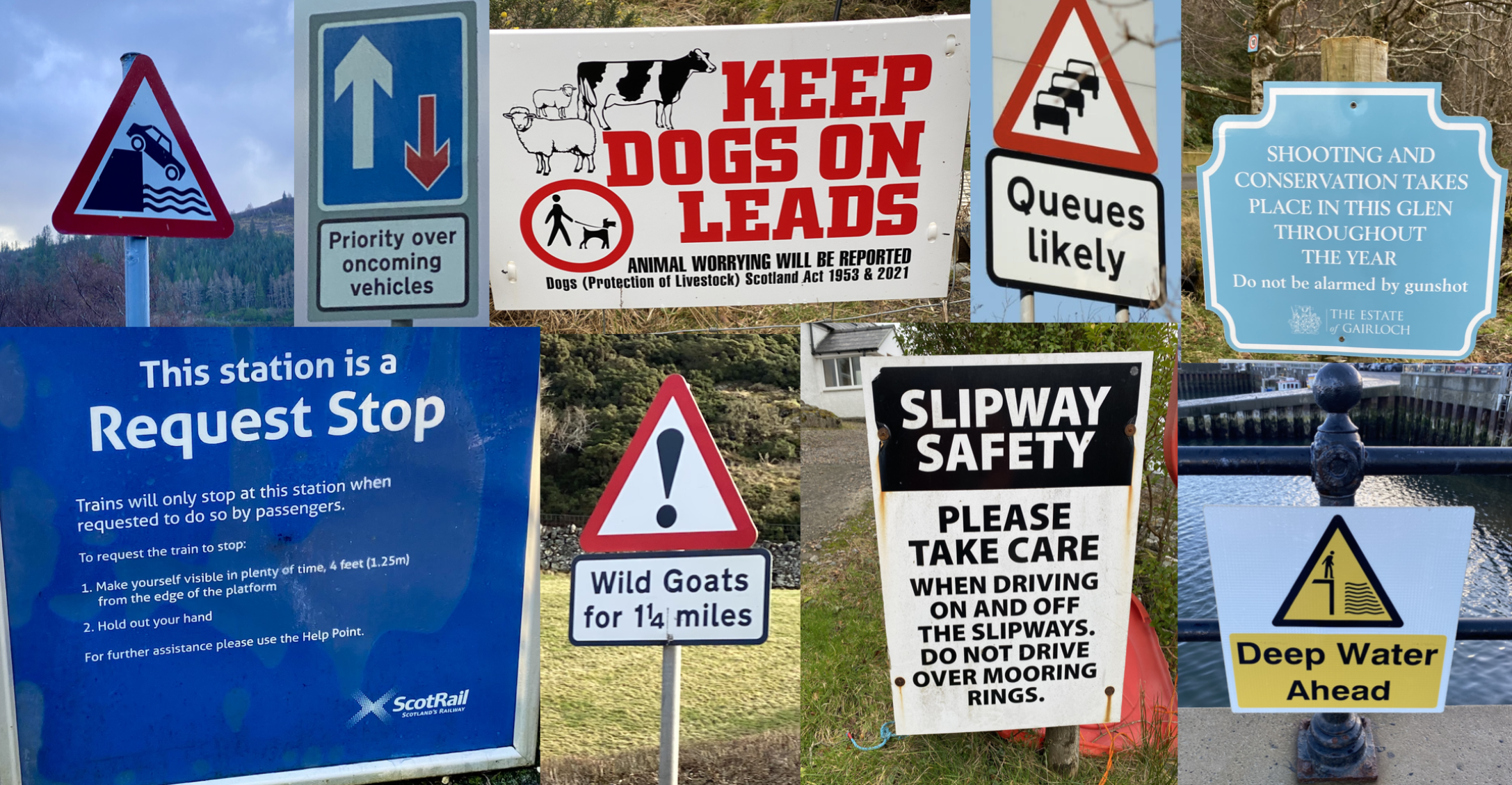
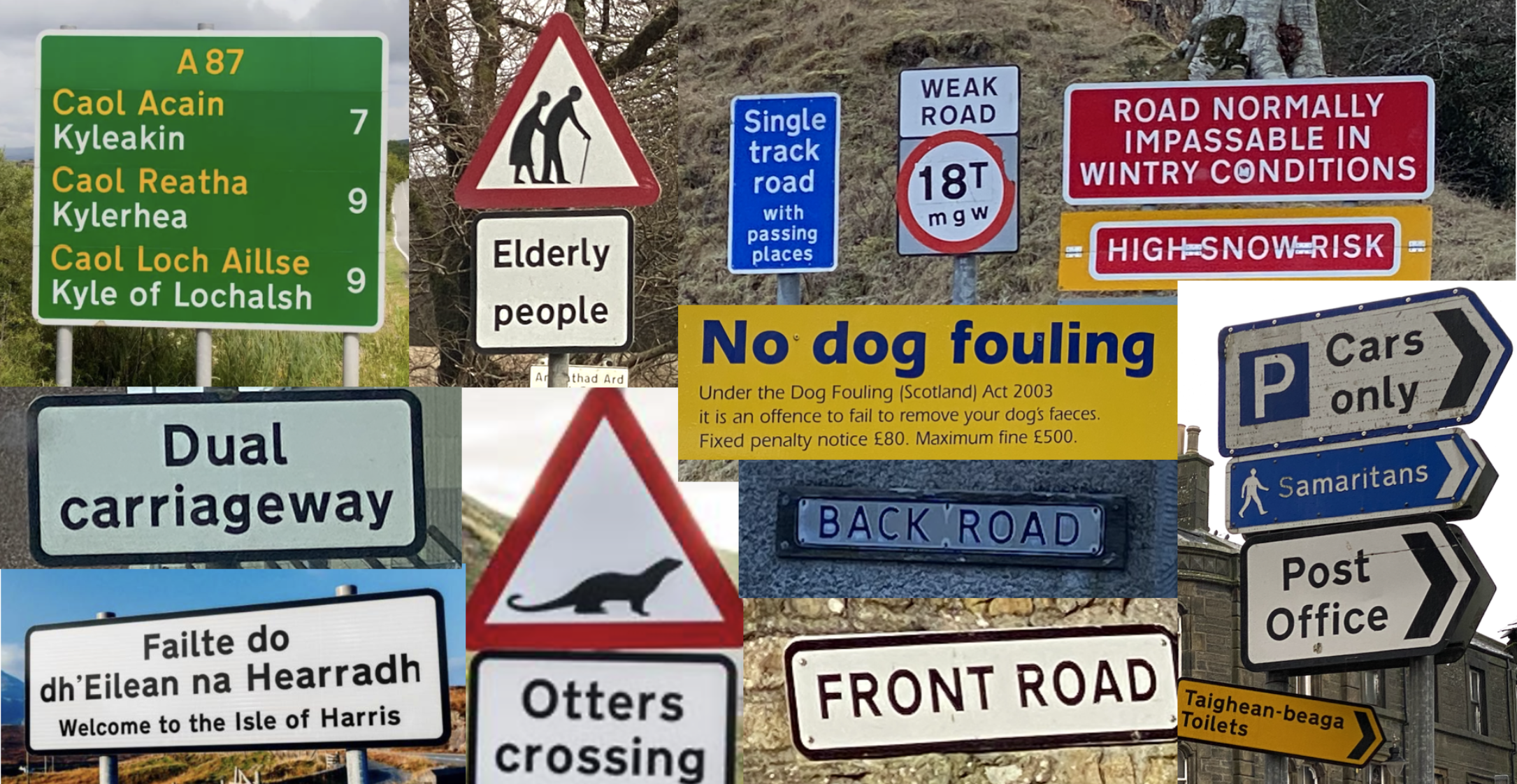
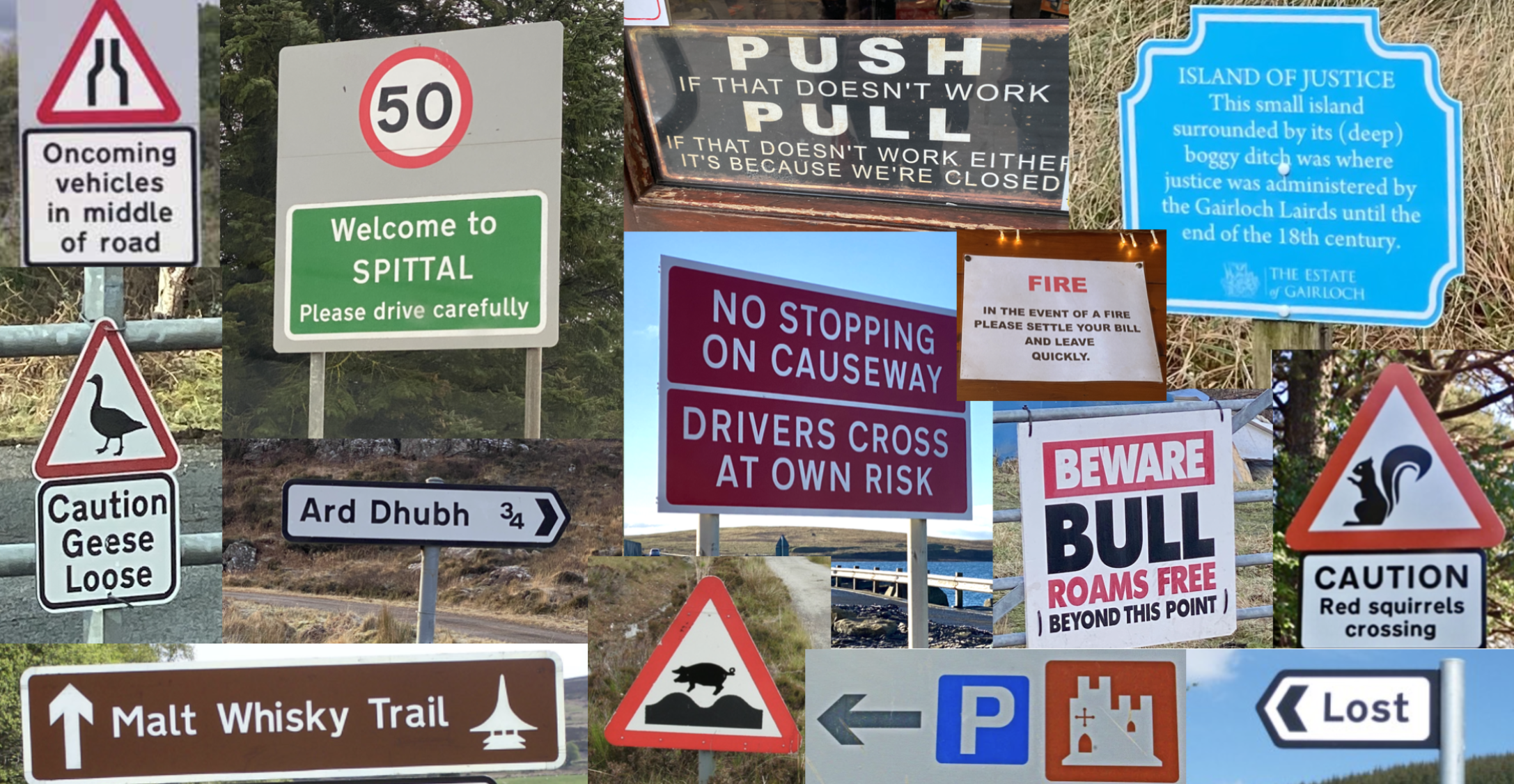
We’ve mastered driving on the left with the steering wheel on the right, but it’s the signage we constantly encounter — even on trails and in establishments — that have us questioning and chuckling and sometimes going back for a second look. Here are a few of our favorites that we’ve managed to snap as we’ve been out and about. We’ll let you draw your own conclusions.
THE ACCENT
This brings me to the trickiest part of communication in Scotland, the brogue. Let me say up front that I absolutely love the Scottish pronunciations and I adore the way certain phrases roll smoothly off the tongue like the fog rolling over the heather on the braes at morning’s first light. I also realize that, over here, we are the people with the accents. But honestly, sometimes trying to understand is like trying to figure out a word riddle, particularly when we encounter someone from Glasgow or a remote isle. Following a conversation with such a person, Judi and I will quickly and quietly step to the side and ask each other, “How much of that did you get?” It’s not uncommon to discover that we each heard something entirely different.
Interestingly, those from over the southern border also have a hard time communicating with some of the Scots. There’s a story about a Scotsman walking through a field. He sees a man drinking water from a pool with his hand. The Scotsman shouts “Awa ye feel hoor that’s full O’ coos Sharn.” (Rough translation: Don't drink the water, it's full of cow…pies.) The man yells, “I’m an Englishman. Speak English. I don't understand you.” The Scotsman shouts back, “I said, use both hands; you'll get more in.”
The point to all of this is that good communication is a two-way venture. The speaker and the hearer must be on the same wavelength. Eye contact is critical because facial expressions give valuable insights to what’s really being said. And clear communication takes time. Judi and I have agreed that our extended time together — without her heading off to a tennis match or me rushing to the airport for another five-day business trip — has forced us to verbally process what each other is saying on a deeper level than we have experienced for many years.
You don’t have to come to Scotland to improve your communication, but if you do, you’re guaranteed a dialectal and cultural bounty to boot. As the Scots say, it will be pure dead brilliant.
Even before we moved into our Scottish cottage, Judi and I were somewhat familiar with the language nuances between the U.S. and the U.K. Here are some of the common Scottish words and terms to which we’ve been reintroduced:
- In Scotland, potatoes are tatties, French fries are chips, and our chips are their crisps. And if you eat too many of any of those, it’s not your pants that you’ll have trouble snapping, it’s your trousers.
- Over here, a jumper is a pullover garment, not someone about to bound off a ten-story ledge; and trainers are not the fit folks at the gym pushing you to do one more pull-up, rather, it’s what you wear on your feet when you’re there working out.
- You might think you would go to the supermarket with your shopping list and push a cart. But actually, you go to the grocery with your messages and wheel a trolley — that is, if you have a pound in your pocket to buy its temporary freedom from the others it’s chained to. And if you have a wee bairn at home, you’ll probably want to toss some nappies in that trolley. And maybe you’ll want a tin of shortbread biscuits and some squash to mix up and wash them down.
- You don’t keep a flashlight in the trunk so you can see what you’re doing at night when you pull onto the shoulder to change a tire. Rather, you keep a torch in your boot so that when you finally get to a passing place you can…try to read the microscopic instruction on the mini tyre compressor you’re glaring at since none of the cars in Scotland these days carry spares. (Good luck if you have a blowout after dark on an unlit single track in the mountains where there are no lay-bys. But I’ll save expounding on that for another blog.)
- There are plenty more. A toastie is not how you feel sitting in front of the coal stove, it’s a grilled sandwich. Being invited for a cuppa means you’re going to drink tea. If you have legal problems, you don’t look for a lawyer but a solicitor — unless you need somebody to defend you, and then you need a barrister. A burn won’t catch on fire because it’s a small stream. A moor is a swamp where numerous burns and the endless Scottish rain pool together. (There are more moors than you imagine.) A lass is a young man. A lassie is a young woman, and when several lassies get together to celebrate one’s upcoming betrothal, it’s a hen party. Bonnie means pretty. You can also say braw or tidy, which is the opposite of hackit. A coo is a shaggy cow, and shag has nothing to do with carpet. I’m sure you ken what I mean.
Even though we’re usually connecting all the dots, we still get caught off guard. Like last week:
Places to fill up the car with fuel are few and far between in the Highlands. If we’re traveling north, the closest station to the cottage is 19 miles, up and around the head of the loch in the village of Lochcarron. After that, it’s 29 miles to the next one in Kinlochewe, and another 32 to the one after that.
Last week, I pulled into Lochcarron station and noticed what looked like plastic flags on the handles of the green pumps. (In Scotland, opposite of what American drivers are used to, green-handles signify unleaded while black indicate diesel. Don’t get them confused!)
Thinking the streamers were tags indicating they were out, I walked in and asked Charlotte, “Do you not have gas today?”
“I’m afraid not,” she replied, “We’ll get some bottles in next week.” Her response slipped right by me because I was straightaway trying to decide if I wanted to chance going 29 or more miles north, or double back south 27 miles, past our cottage, just to fill up.
“But if you’re talking about the pumps,” Charlotte interrupted with a knowing look, “we have plenty of diesel and petrol.” Oh yeah. Petrol! That’s the word. It turns out that what I thought were flags were mini rolls of plastic gloves that pumpers can wear to minimize getting petroleum residue on the hands.
Yes, we’re still learning the lingo.
THE SIGNAGE
We’ve mastered driving on the left with the steering wheel on the right, but it’s the signage we constantly encounter — even on trails and in establishments — that have us questioning and chuckling and sometimes going back for a second look. Here are a few of our favorites that we’ve managed to snap as we’ve been out and about. We’ll let you draw your own conclusions.
THE ACCENT
This brings me to the trickiest part of communication in Scotland, the brogue. Let me say up front that I absolutely love the Scottish pronunciations and I adore the way certain phrases roll smoothly off the tongue like the fog rolling over the heather on the braes at morning’s first light. I also realize that, over here, we are the people with the accents. But honestly, sometimes trying to understand is like trying to figure out a word riddle, particularly when we encounter someone from Glasgow or a remote isle. Following a conversation with such a person, Judi and I will quickly and quietly step to the side and ask each other, “How much of that did you get?” It’s not uncommon to discover that we each heard something entirely different.
Interestingly, those from over the southern border also have a hard time communicating with some of the Scots. There’s a story about a Scotsman walking through a field. He sees a man drinking water from a pool with his hand. The Scotsman shouts “Awa ye feel hoor that’s full O’ coos Sharn.” (Rough translation: Don't drink the water, it's full of cow…pies.) The man yells, “I’m an Englishman. Speak English. I don't understand you.” The Scotsman shouts back, “I said, use both hands; you'll get more in.”
The point to all of this is that good communication is a two-way venture. The speaker and the hearer must be on the same wavelength. Eye contact is critical because facial expressions give valuable insights to what’s really being said. And clear communication takes time. Judi and I have agreed that our extended time together — without her heading off to a tennis match or me rushing to the airport for another five-day business trip — has forced us to verbally process what each other is saying on a deeper level than we have experienced for many years.
You don’t have to come to Scotland to improve your communication, but if you do, you’re guaranteed a dialectal and cultural bounty to boot. As the Scots say, it will be pure dead brilliant.

August 2025
February 2024
January 2024
December 2023
July 2025
June 2025
May 2025
April 2025
March 2025
February 2025
January 2025
December 2024
November 2024
October 2024
September 2024
August 2024
July 2024
June 2024
May 2024April 2024
March 2024February 2024
January 2024
December 2023